Monday, 12 December 2011

Where and How to Find Online Teaching Jobs

Teaching is the best job in the world. You help people. You spend your work life energy participating in an endlessly fascinating process. You also get paid to learn.

Online teaching adds geographical independence and a big dose of entrepreneurship to the life of a teacher.  I've found that to be a very good thing.

As the program advisor and instructor for the University of Wisconsin-Stout's Online Teaching Graduate Certificate Program,  I teach online classes every semester.  Another very important part of my job is helping people find work.

I try to keep our students informed of new jobs as I find them. However,  when I search I find thousands of online teaching jobs.  I can't republish them all on my E-Learning and Online Teaching Jobs Blog. Instead, I want to show you where you can find those job leads for yourself.  (Don't miss the RSS feeds highlighting e-jobs found in the right hand column of this blog.)

I'm convinced, that at this very moment, the perfect online teaching job is waiting for any talented teacher with the right combination of subject matter skills, e-learning training and professional networking.

The E-Learning Employment Triangle:


With the proper qualifications most work will come through your professional network. But that doesn't mean you shouldn't search directly for work and put together the necessary paperwork to land the online teaching jobs you seek.

Here are two job search engines that produce results.  Take the time to set up accounts and upload fresh resumes.  Be sure your online e-portfolios are polished and ready for a critical eye.  Then start searching!

Indeed.com


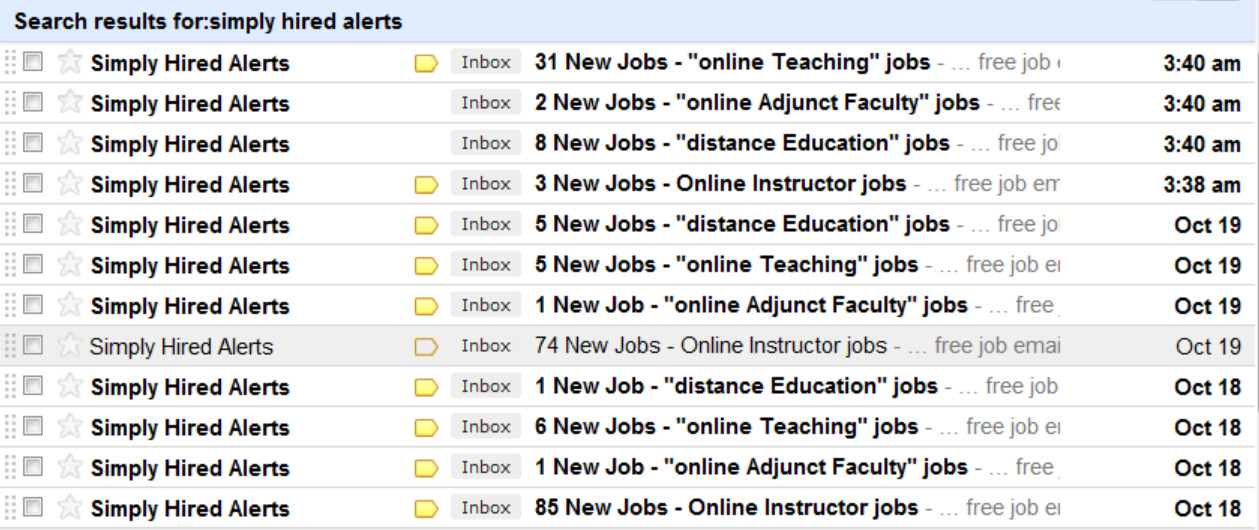
SimplyHired.com


One final hint:  These snapshots represent searches for very recent jobs.  You can also search for all job listings because even if the institution doesn't have a job available right now, you might land one in the future.   Don't under estimate the power of getting your application into the Adjunct hiring pool.  

Read More about Finding E-Learning Jobs! 
Here are more articles about strategies for finding online work, and the kinds of preparation and paperwork you should be working on: 
  1. Where and How to Find E-Learning Jobs
  2. Finding E-Learning Jobs* This will help you see the big picture! 
  3. Finding Online Teaching Jobs: Are you a Online Teaching, Adjunct Instructor, K-12 Virtual Teacher? 
  4. E-Portfolios for Career Development: It's not just resumes anymore! This is why we require a portfolio based on your course work in the E-Learning Certificate Program.
  5. Make Money Teaching Online Cheesy title, but a great marketing plan for anyone looking for an academic online career.
  6. Successful Techniques and Proven Strategies for Finding Online Teaching Work

    Friday, 25 November 2011

    Confessions of a Converted Lecturer: Eric Mazur

    Eric Mazur: "I thought I was a good teacher until I discovered my students were just memorizing information rather than learning to understand the material. Who was to blame? The students? The material? I will explain how I came to the agonizing conclusion that the culprit was neither of these. It was my teaching that caused students to fail! I will show how I have adjusted my approach to teaching and how it has improved my students' performance significantly." 


    Eric Mazur is the Balkanski Professor of Physics and Applied Physics at Harvard University. An internationally recognized scientist and researcher, he leads a vigorous research program in optical physics and supervises one of the largest research groups in the Physics Department at Harvard University.


    Dr. Mazur is author or co-author of 243 scientific publications and 12 patents. He has also written on education and is the author of Peer Instruction: A User's Manual (Prentice Hall, 1997), a book that explains how to teach large lecture classes interactively. In 2006 he helped produce the award-winning DVD Interactive Teaching. (also see:  Peer Instruction: Ten years of experience and results.)

    Wednesday, 23 November 2011

    Blended Learning Revisited

    John Seely Brown
    Dava Newman
    John Belcher
    March 10, 2010


     “Playing at its deepest sense -- making, testing, trying, riddling the system -- that’s the thing.... If that isn’t an interesting description of deep research, I don’t know what is.”  ~John Seely Brown


    Screen shots from Dr. Brown's Lecture


    Wednesday, 9 November 2011

    A day in the life of an online virtual high school teacher

    2011 National Online Teacher of the Year: Kristin Kipp

    Teacher at Colorado's Jefferson County's 21st Century Virtual Academy


    Colorado teacher Kristin Kipp is living the dream of every teacher. She's teaching effectively and making a difference in the lives of her students. She's also home with her children as they grow and prosper.

    Skill, dedication, and talent open doors to opportunities we might not even realize are there.

    Congratulations Kristin!  Keep doing the good work!

    Saturday, 22 October 2011

    Graduates of the Certificate Program: Let us know?

    All call for Graduates of the University of Wisconsin Stout E-Learning and Online Teaching Graduate Certificate Program. 

    I've sent out a request to all graduates of our program to complete a follow up survey.  I want to find out where you are and what you are doing with your E-Learning Certificate.  Special thanks to all who have replied!  The Wordle below was created with the text from just one of the questions on our survey:

    Has earning your certificate changed your work life?


    If you are a graduate of our program who has not yet completed the survey, please write me and I'll send you the link.

    Dennis O'Connor
    Program Advisor
    E-Learning & Online TeachingSchool of Education
    Online Professional Development
    University of Wisconsin-Stout
    Wisconsin's Polytechnic University
    530-318-1145 (Cell)
    Skype: wiredinstructor2

    oconnord@uwstout.edu

    Friday, 23 September 2011

    Learning to learn online as you learn to teach online

    Many traditional learners who enter the Online Teaching Graduate Certificate program at UW-Stout go through a period of adjustment during the first course, E-Learning for Educators.   There is so much information in the class, so many new ideas, so many intriguing resources that the desire to read everything and click every link can be overwhelming.

    I like to remind folks that our classes are "8 week intensives".  The courses earn the same number of credits as a traditional face to face 18 week graduate course.  I think that helps when to adjusting to the work load.

    The other thing I do is send our students to Joan Vandervelde's Tips on reading during an online class.  Joan's great advice goes a long way to help students learn hypertext reading habits.  
    I also remind our students that each course remains open at least a year. This means they return and review the resources and discussions as they see fit.  Indeed, those that go on to the E-Learning Practicum class are expected to revisit each of their courses as part of a culminating e-porfolio project.

    Traditional students are stuck on the idea that they have to read everything and follow every link.  You just can't do that in 8 weeks or 8 years. Reading hypertext resources requires persistence, and focus. The information filtering theme in the first e-learning course is about selectively pursuing interests, and using the Diigo social bookmarking system to save, tag, annotate and share resources you want to revisit or remember in the future.

    When I first started as an online student I made a notebook of printed pages for each of my classes.  I recall the sense of old time order and control it gave me to print the assignments, punch three holes, and divide it all into flip book order.  I think I did that for the first 4 courses of my masters degree.  
    Luckily I evolved out of that habit; saving a forest over the last 10 years!

    The journey from online student to online teacher is an intense and fascinating experience.  Changing ingrained learning habits, understanding how to think with technology, figuring out how to project your voice and mind across the Internet, and being able to tolerate the ambiguity of a constantly changing digital landscape will help us all be lifelong learners in the 21st Century!

    A question for all who teach and learn online: Which 'old school' habits do you want to change? Which will you hold on to?

    Thursday, 22 September 2011

    How to start your own virtual school


    Follow this Recipe: 

    iNacol: well documented theoretical and practical foundations


    + Moodlerooms: affordable course management System 


    + Utah OpenCourseware: award winning open source online core curriculum 


    + UW-Stout: Online Teacher training 

    +  Courage and Vision

    You're just a few clicks away from having a running start on your new virtual school!  Save yourself a year's worth of meetings and research.  This formula gives you the ingredients.  Just add courage and vision and start cooking.


    +

    +


    +


    Girls Generation - Korean