Thursday, 12 January 2012

Time Management for Online Teachers


Time is Money On Line

Time Management: Teaching Online:
A great list of tips and advice from veteran online teacher Dr. Kay Lehmann.
http://www2.uwstout.edu/content/profdev/rubrics/time_management.html

Be Efficient, Not Busy: Time Management Strategies for Online Teaching "Online teaching redefines the faculty member’s schedule. The feeling of being a 24/7 professor can lead to frustration. Managing one’s time as an online teacher can be a challenge."

Time Management for Online Teachers. This is a breeze video/audio archive. Give it a look/listen? http://breeze.boisestate.edu/p82935848/


Time Management Strategies for Online Teaching. This is an excellent, relatively recent (2006) academic research paper on time management. The authors compare Face to Face with online teaching in a number of areas. http://itdl.org/Journal/Feb_06/article01.htm


Time Management Tips for Online Instructors. This is basic advice for k-12 online teachers from the Connecticut Virtual School http://www.ctvirtuallearning.com/timemantips.cfm

Monday, 2 January 2012

Touch Screen Tech: Looking ahead helps us see our future

The Touchy-Feely Future Of Technology

This NPR audio and written piece looks at touch screen technology with a perceptive and wide lens.  As smart phones and tablet computers become ever more widespread this thoughtful article begins by looking at the science fiction origins of the idea that we can wave our hands or touch a screen to control a computer.

The author also discusses the implications and applications of touch screen tech in education, science, medicine, and sociology.

This article will help any educator interested in the near future application of technology for e-learning  to think more broadly. Just close your eyes and listen to the podcast.  Stitch together the ideas and prognostications as you imagine what teaching and learning online will look like in the near future.

Its easy for our thinking to get 'siloed' within a particular set of ideas. Our attention  takes narrows focus on specific elements of e-learning and we miss the larger picture.

This article will help you think about what is coming near term in technology. Taking the time to think may help you find where you might fit (now or someday soon).

Don't Lecture Me!


The flipped classroom has gotten a good deal of press.  The Khan Academy in particular has popularized the idea of flipping the lecture out of real time and placing it online in video format as homework.  This approach frees up teaching time for hands on work, group discussion and individualized tutoring. In short, it gets teachers out from behind the lectern and into direct interactions with their students. 

Physicists Seek To Lose The Lecture As Teaching Tool by Emily Hanford interviews Eric Mazur a lauded master teacher of Physics at Harvard and MIT.  Mazur states that the key is to get students to do the assigned reading (the information flow) before they come to class.  He then talks about how he teaches huge classes without resorting to traditional lecture techniques.

As this article will explain, the ineffectiveness of the 'Lecture' and the realization that students learn by discussion and interaction isn't new. Mazur has been doing this for 20 years. Indeed, it has been well established that the ancient mode of lecture just isn't effective for the vast majority of students.  (Also see in this blog: Confessions of a Converted Lecturer: Eric Mazur)

Once faculty make peace with the changing role of teacher (from lecturer to coach) students learn more.  

This is a hard transition that many traditional lecturers are not willing to make. This is also reason why traditionalist lecturers have difficulty with online teaching. Far too many college instructors assume that just putting up video of their lectures along with writing assignments and tests will work. (We know it won't.)

Unlike k-12 teachers who have a deep understanding of how students learn, many college lecturers are not trained educators. Many lecturers are hired for their content expertise, not their teaching skills. They teach as they were taught, via lecture. This perpetuates a flawed method long proven to be ineffective. (For more on effectiveness of the lecture method see Twenty terrible reasons for lecturing.)

In an online environment refined teaching skills are essential. Online teachers must use the technology to personally connect with each of their students.  The remote sage on the stage just doesn't work in modern e-learning environments.  Learning comes from interaction with a community of learners and facilitators.

Online or face to face, educators must promote discussion, hands on engagement, and digital manipulation of ideas if they want more learning in their classes.

For more reporting on this topic see:  Don't Lecture Me!

Monday, 12 December 2011

Where and How to Find Online Teaching Jobs

Teaching is the best job in the world. You help people. You spend your work life energy participating in an endlessly fascinating process. You also get paid to learn.

Online teaching adds geographical independence and a big dose of entrepreneurship to the life of a teacher.  I've found that to be a very good thing.

As the program advisor and instructor for the University of Wisconsin-Stout's Online Teaching Graduate Certificate Program,  I teach online classes every semester.  Another very important part of my job is helping people find work.

I try to keep our students informed of new jobs as I find them. However,  when I search I find thousands of online teaching jobs.  I can't republish them all on my E-Learning and Online Teaching Jobs Blog. Instead, I want to show you where you can find those job leads for yourself.  (Don't miss the RSS feeds highlighting e-jobs found in the right hand column of this blog.)

I'm convinced, that at this very moment, the perfect online teaching job is waiting for any talented teacher with the right combination of subject matter skills, e-learning training and professional networking.

The E-Learning Employment Triangle:


With the proper qualifications most work will come through your professional network. But that doesn't mean you shouldn't search directly for work and put together the necessary paperwork to land the online teaching jobs you seek.

Here are two job search engines that produce results.  Take the time to set up accounts and upload fresh resumes.  Be sure your online e-portfolios are polished and ready for a critical eye.  Then start searching!

Indeed.com


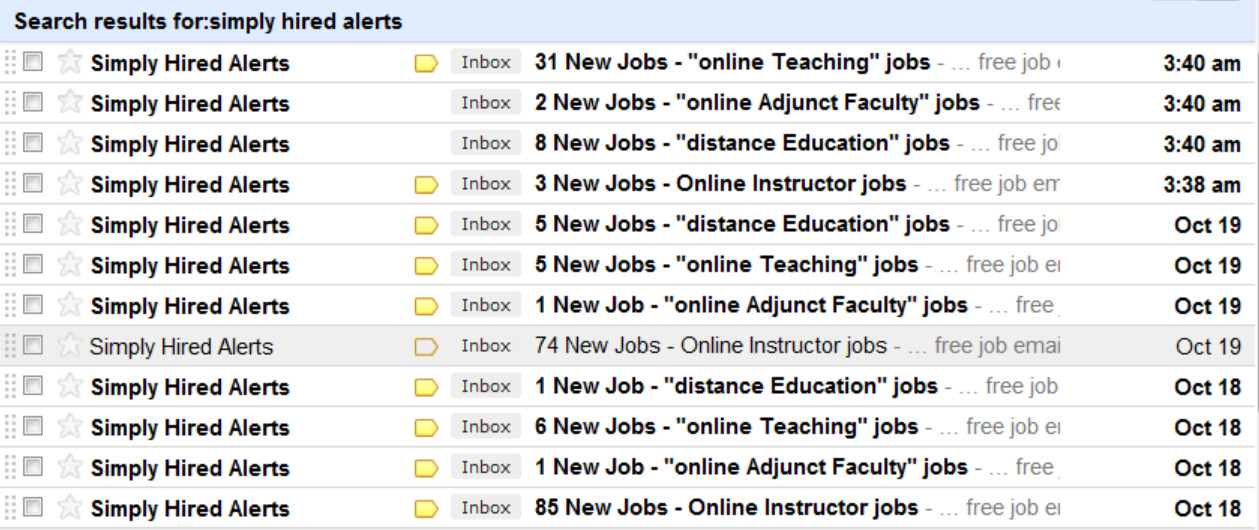
SimplyHired.com


One final hint:  These snapshots represent searches for very recent jobs.  You can also search for all job listings because even if the institution doesn't have a job available right now, you might land one in the future.   Don't under estimate the power of getting your application into the Adjunct hiring pool.  

Read More about Finding E-Learning Jobs! 
Here are more articles about strategies for finding online work, and the kinds of preparation and paperwork you should be working on: 
  1. Where and How to Find E-Learning Jobs
  2. Finding E-Learning Jobs* This will help you see the big picture! 
  3. Finding Online Teaching Jobs: Are you a Online Teaching, Adjunct Instructor, K-12 Virtual Teacher? 
  4. E-Portfolios for Career Development: It's not just resumes anymore! This is why we require a portfolio based on your course work in the E-Learning Certificate Program.
  5. Make Money Teaching Online Cheesy title, but a great marketing plan for anyone looking for an academic online career.
  6. Successful Techniques and Proven Strategies for Finding Online Teaching Work

    Friday, 25 November 2011

    Confessions of a Converted Lecturer: Eric Mazur

    Eric Mazur: "I thought I was a good teacher until I discovered my students were just memorizing information rather than learning to understand the material. Who was to blame? The students? The material? I will explain how I came to the agonizing conclusion that the culprit was neither of these. It was my teaching that caused students to fail! I will show how I have adjusted my approach to teaching and how it has improved my students' performance significantly." 


    Eric Mazur is the Balkanski Professor of Physics and Applied Physics at Harvard University. An internationally recognized scientist and researcher, he leads a vigorous research program in optical physics and supervises one of the largest research groups in the Physics Department at Harvard University.


    Dr. Mazur is author or co-author of 243 scientific publications and 12 patents. He has also written on education and is the author of Peer Instruction: A User's Manual (Prentice Hall, 1997), a book that explains how to teach large lecture classes interactively. In 2006 he helped produce the award-winning DVD Interactive Teaching. (also see:  Peer Instruction: Ten years of experience and results.)

    Wednesday, 23 November 2011

    Blended Learning Revisited

    John Seely Brown
    Dava Newman
    John Belcher
    March 10, 2010


     “Playing at its deepest sense -- making, testing, trying, riddling the system -- that’s the thing.... If that isn’t an interesting description of deep research, I don’t know what is.”  ~John Seely Brown


    Screen shots from Dr. Brown's Lecture


    Wednesday, 9 November 2011

    A day in the life of an online virtual high school teacher

    2011 National Online Teacher of the Year: Kristin Kipp

    Teacher at Colorado's Jefferson County's 21st Century Virtual Academy


    Colorado teacher Kristin Kipp is living the dream of every teacher. She's teaching effectively and making a difference in the lives of her students. She's also home with her children as they grow and prosper.

    Skill, dedication, and talent open doors to opportunities we might not even realize are there.

    Congratulations Kristin!  Keep doing the good work!
    Girls Generation - Korean